
‘Too Dangerous’ to know: AI’s scaremongering playbook, HRT, & Fable 5
Fable 5, the “most powerful AI model ever made”, was released by Anthropic on June 9 2026, then promptly retracted just three days later. While it was live, Fable downgraded results about gender affirming healthcare information to its Opus 4.8 model, its former leading AI-model at the time.
In a conversation reported to Repro Uncensored on June 12, just hours before access to Fable was removed citing security concerns from the US government, a transgender woman asked Fable for information about male-to-female Hormone Replacement Therapy (HRT). HRT is a standard part of gender-affirming care for both cisgender and transgender people, and an essential health topic. However, Fable quickly flagged this query as a ‘cybersecurity or biology’ issue, downgrading its answer to be handled by Opus, while making sure to promote that its Mythos’ level capabilities were coming soon.
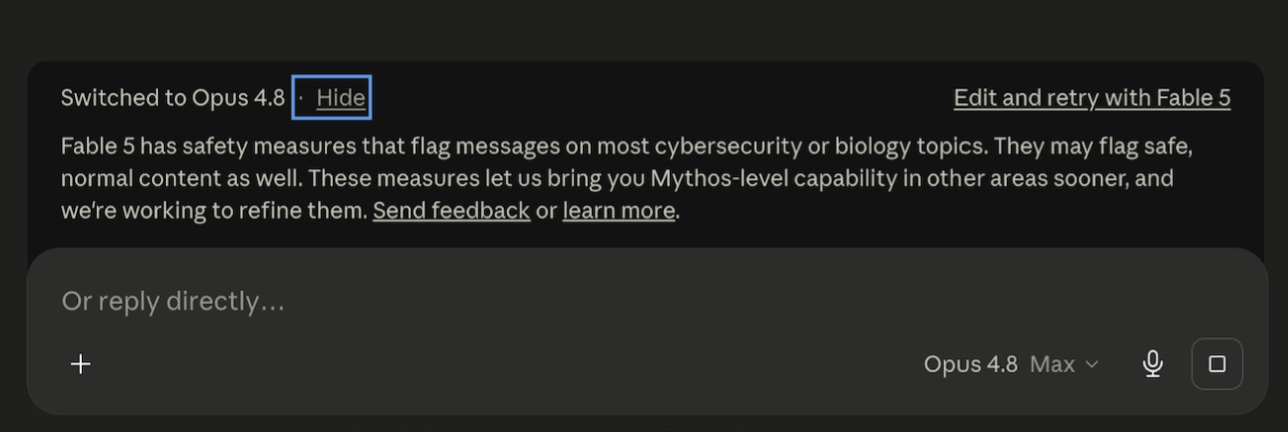
Anthropic claimed that Fable’s capabilities exceeded those of any model they’d publicly made available, with exceptional, state-of-the-art performance AI-capability across many topics, including biology. They also made it clear that strong and conservative guardrails were purposefully designed into the model. This was to enable a quicker release of the model to the public, and prevent things like cybersecurity issues occurring through model misuse, or bioweapons from being developed. But perhaps the safeguards were too strong. As well as refusing to answer HRT questions, The Verge reported that answers to high school level biology questions like ‘what causes hayfever’, ‘tell me about cell membranes’, and ‘what is DNA’ also triggered Fable’s safety mechanisms.
The ‘Too Dangerous’ Narrative
Anthropic has been working on their Mythos AI model for some time, declaring it ‘too dangerous for release’ just a few months ago. Fable was a ‘Mythos-class model made safe for general use’, briefly released with the caveat that it comes with risks. Therefore Anthropic put additional guardrails in place to mitigate misusing the model, which they said could cause ‘serious damage’.
The ‘too dangerous’ narrative is not new, and has become a standard marketing tactic for AI companies in recent years. Since 2019 when OpenAI warned that its text-generation model GPT-2, was so potent it would be irresponsible to release it (spoiler: they subsequently did release it), the ‘too dangerous’ framing has become an industry standard and PR playbook for AI companies. OpenAI has even published a Staged AI Deployment paper on arXiv, noting that AI model releases should follow a sequence of a staged disclosure, controlled access, partner evaluation, and delayed weight release protocol.
Inciting fear and moral panics over access to knowledge and the notion that something is ‘too dangerous’ for the public to access, has long been used to restrict access to information and services. Throughout history, books deemed too dangerous or too controversial have been banned - from George Orwell's 1984, Salman Rushdie’s The Satanic Verses, and Alice Walker's The Colour Purple, to mass-banning of LGBTQI+ books across US curriculums in recent years. Banning information is not only about banning words on pages, it’s about control. It limits freedom of expression, restricts critical thinking, erases diverse perspectives, and undermines democratic societies.
Another example of moral panics features the contraceptive pill and pregnancy tests, in the 1970s. As legal restrictions were lifted enabling women access to the pill and pregnancy tests, greater bodily autonomy without the need for doctors (or men making decisions about women's bodies) became reality. This was was met with strong patriarchal pushback, with access and information of this kind deemed too dangerous for women to handle alone, in an attempt to continue gatekeeping womens bodies. Doctors, legislators, and pharmaceutical companies all argued women could not be trusted unsupervised with this information, that they might misread results, make the wrong decisions, or cause harm to themselves. Overall, the ‘too dangerous’ narrative was used as a guise to make women appear to be people who needed protecting, rather than free individuals capable of making independent decisions.
Returning to 2026, in the three days that Fable was live, it appears that Anthropic believes HRT information is also too dangerous to know. HRT information is generally not something that poses cybersecurity threats, and is not likely to lead to the development of bioweapons. It might however help some transgender women feminise and develop breast tissue, relieve some cisgender women’s menopause symptoms, and treat things like hypogonadism in cisgender men (amongst many other use cases of HRT). These examples all appear to be non-threatening and gender-affirming.
As Anthropic positions such information as potential threats and dangers, it's a stark reminder that freedom of access to information cannot be taken for granted. Living in a world where global big tech companies like Anthropic control what information can be searched, questioned, interrogated, and accessed, as well as who gets to access it, we must remember to be critical, speak out when injustices rise and information is restricted, and never accept information censorship as normal.
Would a cisgender person searching for HRT information have had their answers downgraded? We can’t answer this question, but we do want to hear about your experiences with Generative AI queries. Have you had searches or conversations in GenAI systems, search engines, or other platforms restricted, blocked, or felt the answers just weren’t quite right?
Report your experiences with Gen AI to Repro Uncensored via the Report an Incident form. Individual cases are dismissed as mistakes. Patterns are not. Collective documentation is one of the few ways to expose the gap between platform policy and reality, and to demand accountability.