
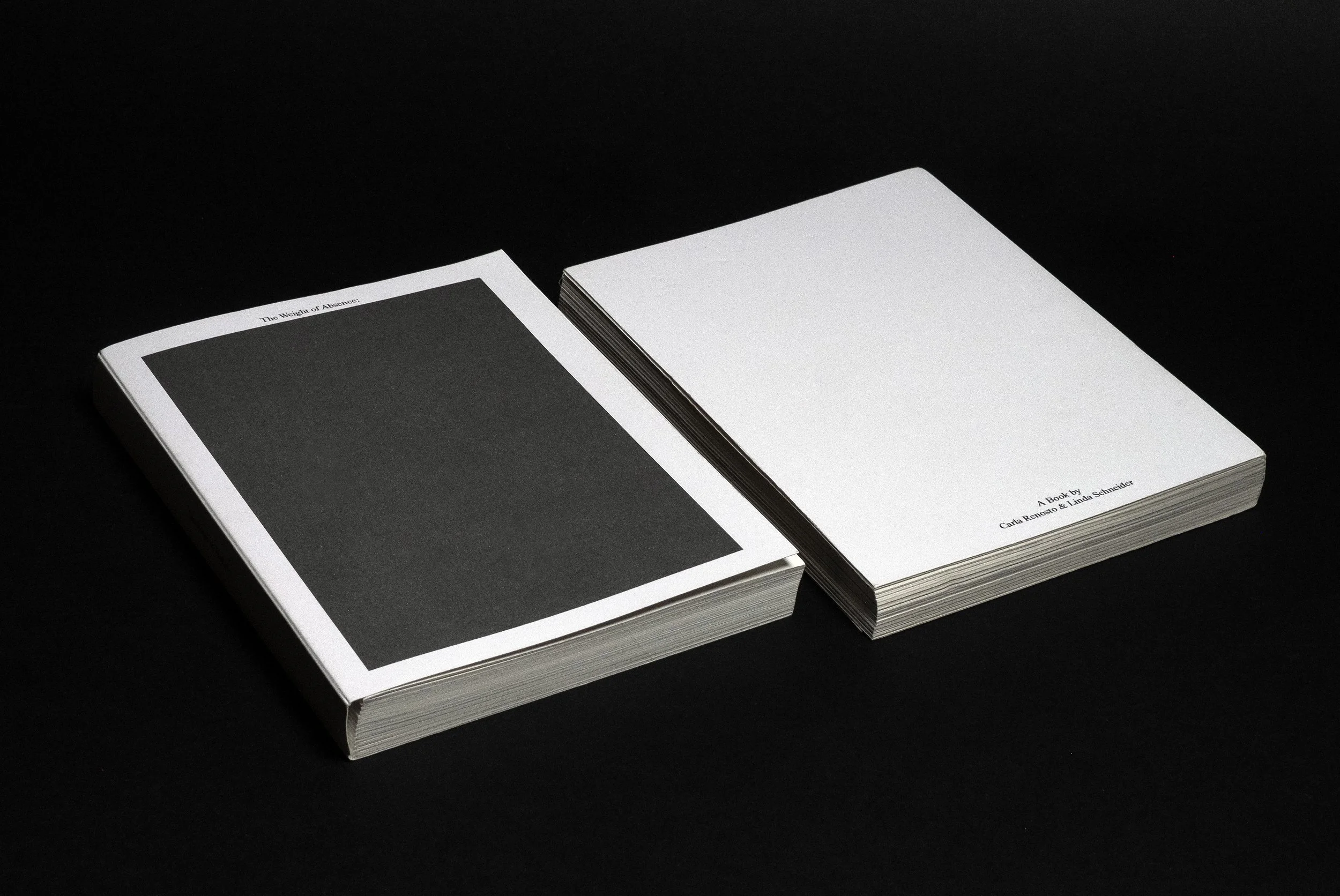
The Weight of Absence: Meditations on Censorship
A book by Carla Renosto and Linda Schneider drawing on Repro Uncensored’s research
A redacted sentence, a blurred photograph, a post that reaches no one. The Weight of Absence explores how censorship moves between visible acts of concealment and mechanisms that leave few traces.
Developed as a graphic design MA thesis at the Royal Danish Academy in Copenhagen, the book brings together text and image across seven censorship markers and mechanisms. Its chapters move from explicit, physical forms of restriction towards the opaque processes of online moderation and suppression.
Seven ways of encountering censorship
The book is structured around seven censorship markers and mechanisms, moving from visible, material interventions towards forms of restriction that remain opaque or difficult to detect. Redaction, concealment and destruction sit alongside the less visible processes that determine whether information reaches people online.
Each chapter stands on its own. Readers can enter the book anywhere, move between chapters and explore at their own pace. This open structure reflects the designers’ understanding that censorship has no single definition or fixed boundaries. It operates through different intentions and systems, producing distinct visual forms.
What is allowed to remain?
At the heart of the book is a question about power: what happens when an image, a story or a voice challenges the boundaries of a community, institution or regime?
Carla and Linda explore how something perceived as dangerous, sensitive or disruptive becomes subject to restriction. Across these different contexts, censorship shapes what can remain visible, what must be concealed and what disappears altogether.
The book offers a deliberately partial view of this expansive subject. Its selection of texts and images reflects what the designers encountered, what they could access and what they felt was most urgent to examine.
Repro Uncensored’s research on the page
Carla and Linda approached Repro Uncensored about incorporating our research into their project. That research became the foundation of the book’s final two chapters, Moderating and Vanishing, drawing on:
We asked artists in China about censorship. Here’s what they told us.
Australia: Sexual Content Moderation and Platform Governance Through a Sex-Positive Framework
The designers treated these texts as visual material. Passages are interrupted, concealed or layered until their meaning becomes difficult to access. In another experiment, selected “trigger” words disappear from a text and reappear on the following page, separated from their original context.
These interventions invite readers to encounter censorship through the page itself and consider how moderation systems interpret language, restrict visibility and shape access to information.
Making absence tangible
For Repro Uncensored, this collaboration offers another way to engage with the censorship we document. Design makes processes that can be difficult to observe tangible, while asking whose experiences, knowledge and voices become harder to find when information disappears.
A small number of copies have been produced for the thesis and its presentation. Carla and Linda are exploring wider publication, and we will share updates as the project develops.
Our feature includes selected spreads, videos and a closer look at how Repro Uncensored’s research informed the book.
Credits
Writing and design: Carla Renosto and Linda Schneider
Additional contributions and featured work: Repro Uncensored, Akkara Naktamna, Éric Baudelaire, Bedside Productions and Jan Henrik Arnold.
Book images: Courtesy of Carla Renosto and Linda Schneider.
Download the Book
Read about the book on our Substack