
Rebalancing Power: What the Melbourne Declaration Reveals About the Crisis in Gender Equality- Women Deliver 2026
By Luisa Orozco
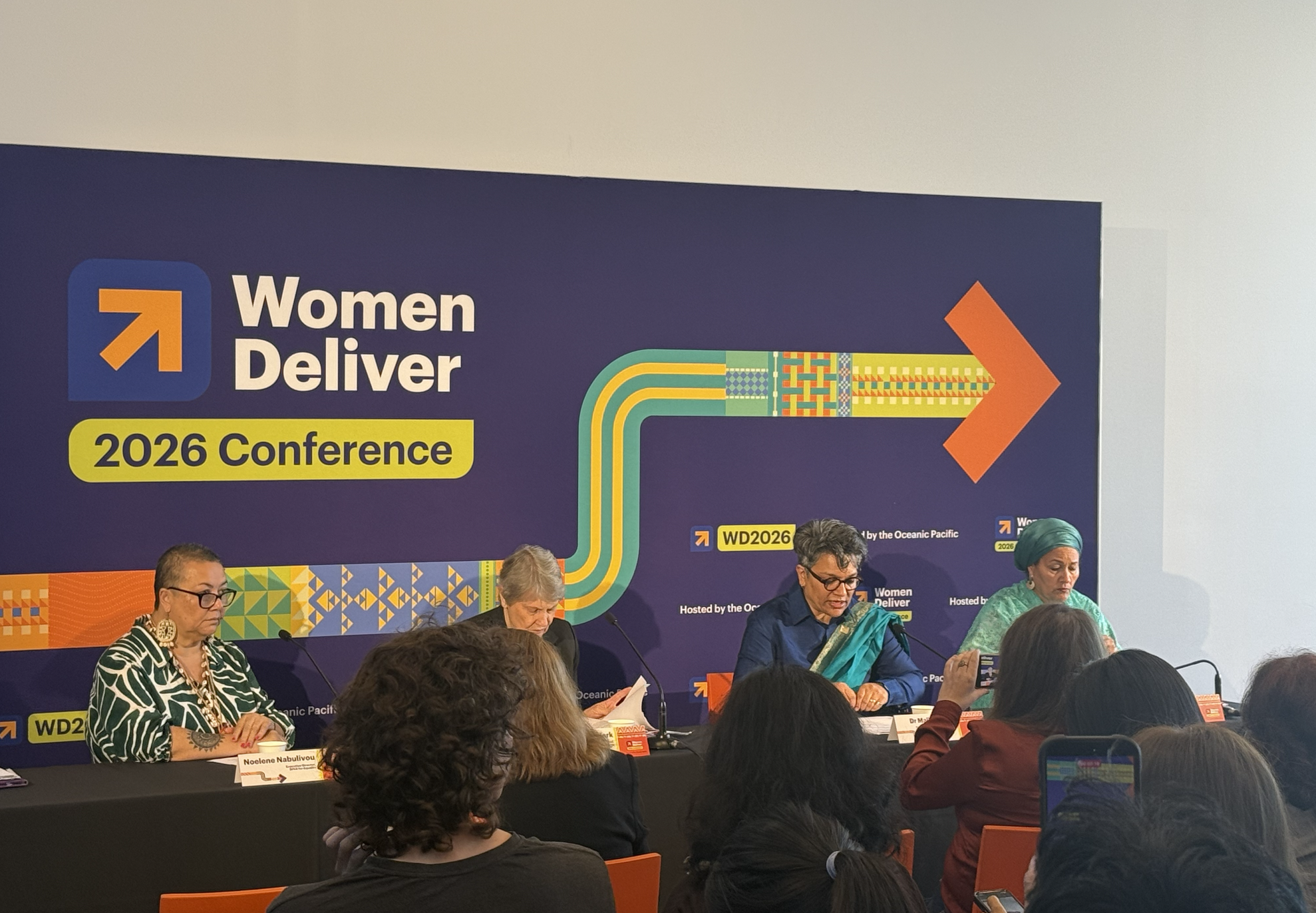
Credit: Repro Uncensored
WD2026 Opening Press Conference
At a time when global commitments to gender equality appear increasingly fragile, a new manifesto is calling not for incremental reform, but for structural overhaul. The Melbourne Declaration for Gender Equality, presented in Melbourne, Australia, during the Women Deliver 2026 Conference (April 27–30), positions itself as both a diagnosis and an intervention: a response to what its signatories describe as a system in crisis.
“The systems that have shaped the gender equality ecosystem are crumbling,” the document states, warning that they “have not always worked for the majority of adolescent girls, women, and gender-diverse people.”
This is not a marginal critique. It is a direct challenge to the architecture of global gender governance. The declaration situates gender inequality within a broader global breakdown. It points to a convergence of forces: democratic backsliding, rising authoritarianism, attacks on sexual and reproductive health and rights, and shrinking civic space.
“Governments and political actors are actively rolling back, ignoring, and undermining human rights,” the text notes.
But the diagnosis goes further: it links these political dynamics to structural economic conditions, such as debt, austerity, and global financial rules that constrain states’ ability to deliver services.
At the same time, it highlights the expansion of militarism: “States increasingly pour resources into war rather than investing in people’s rights and needs.”
In this framing, gender inequality is not treated as an isolated issue. It is embedded in overlapping systems of power, economic, political, and geopolitical.
A critique from within
One of the declaration’s most striking features is that it turns its critique inward, toward the very ecosystem it emerges from. Specifically, it argues that international development and gender equality work have been shaped by “histories of colonialism, racism, and neoliberalism,” producing a system where accountability flows upward rather than outward.
“Accountability is directed more to funders than to people,” the document states. It adds that “philanthropy itself is too rarely held accountable to the people it claims to serve,” and that international NGOs “all too often substitute for the State in the delivery of essential services.”
This is a significant departure from conventional narratives. Rather than positioning NGOs and philanthropic actors as neutral or inherently beneficial, the declaration frames them as part of a system that can reproduce inequality and distort priorities.
In response, the declaration calls for a reorientation: back to the State as the primary duty-bearer for human rights.
It commits to “centering States’ human rights obligations to all people,” including the provision of essential services and the protection of bodily autonomy, freedom from violence, and freedom from discrimination.
At the same time, it emphasizes that this shift must be accompanied by strong civil society capable of holding governments accountable. A “vibrant, progressive local and national civil society,” it argues, is “essential for holding States accountable to their human rights obligations.”
Another key shift proposed in the document is conceptual: a move away from charity toward solidarity.
“For too long, much of the gender equality ecosystem has operated on a model of charity that creates hierarchies in funding, agenda setting, and decision making,” it states. In contrast, solidarity is framed as a model that recognizes interdependence and seeks to redistribute power.
Yet for all its structural ambition, the declaration leaves a critical axis of power underdeveloped: the role of digital infrastructure in shaping who is seen, heard, and able to participate in public life.
At a moment when access to sexual and reproductive health information, community organizing, and cultural expression is increasingly mediated and restricted by private platforms, the absence of a clear analysis of Big Tech is striking.
If power is to be truly rebalanced, it cannot stop at states and funding models. It must also confront the opaque systems that govern visibility itself.
Without this, the question remains: who gets to exist, organize, and access information in the spaces where public life now unfolds, and who is silently excluded?