
The Hidden Labor of Hong Kong: Care Work Amidst Tragedy and Repression
By Lily Wass
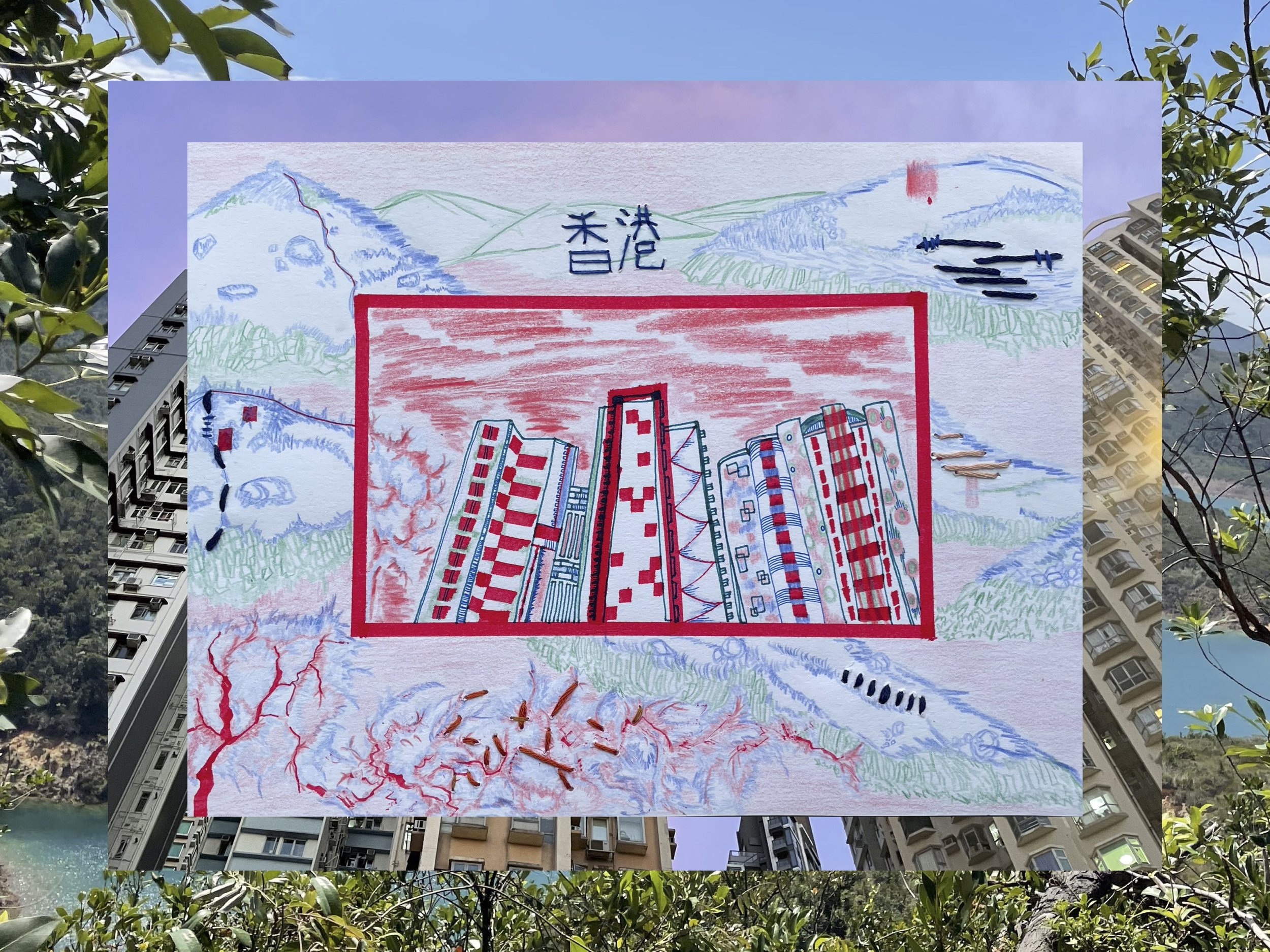
For two years the place I lived did not make sense to me, and while watching it vanish through a plane window gave me more to see, it did not give me clarity about what the city is to me.
But when the crisis reached me through my phone as all crises today do, I cried repeatedly for days. I was in a new city. Not knowing where I was going made every walk feel longer. As I moved through the sounds of grief coming through the tin stereo of my phone, the sky opened up for me and only me, and it began to rain.
I am referring to the Wang Fuk Court fire in Hong Kong. That first night, I went to sleep thinking the death toll was stuck at 13. Two months later, the official total would be announced: 168 lives lost, some knowing only the first six months of life, others reaching their 98th year.
Since the fire began, I have consumed so many posts about the disaster that the algorithm began to reward me with content about all kinds of fires, orange-tinted photos of flames moving through houses that had already burned up weeks before. The digital machinery thought that my double-tapping, the seconds that elapsed while I studied and translated posts falling from the burning in Hong Kong, was an indication of an interest. The pipes felt rusted and a little insidious, like talking to a chatbot that is overly sycophantic, even about things it shouldn’t be.
During the two years I lived in Hong Kong, we’d joke about the fire alarms in our potentially illegally subdivided apartments not working and the unnervingly high number of bus accidents in a city known for its twisting roads and inclines. Combining the two, one night after karaoke my friend and I spent an extra hour together on the upper deck of the bus, craning our necks to see the lingering smoke from a building that had brought traffic to a halt. Prone to tending a bird’s nest of intrusive thoughts, I took some comfort in living close to the ground floor.
It was a dizzying landscape where businesses came and went overnight. Down the street from me, a restaurant’s modern take on a dai pai dong, or open-air food stall, that regularly had a wait turned into a dusty industrial space in a blink. Peering through the unlocked door, silence gave way to the dust already settled beneath the store’s bare walls. With no way to prove anything had ever been there, my memory of this place teetered on hallucination. This is how I watched many establishments disappear, like toys that moved when the door was closed—hastily tearing down the flashing signs and packing away the folding tables in the middle of the night. Or in reverse: rows of vegetables and fruits that beamed beneath the fluorescent lighting of what had been an abandoned lot the day before. All cities rely on the trash takers, floor sweepers, and delivery drivers keeping things in order out of our oblivious sight. But the pace they danced to this inaudible waltz seemed to speed up and up.
The ability of places to write and rewrite themselves inexplicably does not come from nowhere. Like the rest of the world’s capacity to rapidly transport clothes, produce, computer parts constructed in one place with minerals extracted from another, the labor behind these products seems so far away that we approximate it as having no discernible source. Beneath the veil of obliviousness, the source remains exploitation of the earth’s resources and its people. Unregulated labor shapes raw materials into consumable products at a rate perpetually redefining the upper limit. Quality yields to profit, the most tangible and necessary of all outcomes. In the case of Wang Fuk Court, where a written warning for improper fire prevention methods was issued six days before, it seems obvious that all the money-making shortcuts around the complex’s renovations had laid the pretext for the place to burn. After nearly a decade of failed building inspections, residents faced the worst manifestation of what they had long feared.
The last time Wang Fuk Court residents saw their apartment buildings intact, the estate blocks were swathed in a brilliant artificial green. It was the color of the synthetic netting erected after a massive renovation project began the year before. Originally posed as repairs for the buildings’ aging infrastructure, the project ballooned into a HKD$330 million (USD$42.4 million) deal that cost over double initial estimates. The renovation contract went to Prestige, a construction company with a record of ignoring safety regulations. The pattern would then repeat itself. Prestige went on to replace regulation compliant mesh with the cheap green flammable material that saved them 50% of costs.
A year later this colorful plastic netting immolated into a black husk, the material transformed into a gasoline that enabled flames to bound vertically and laterally between buildings. Flames engulfed seven of the eight buildings in mere hours. At the same time, Styrofoam installed to protect apartment windows from the renovations conveniently ushered the fire inside. Amidst all this combustion, residents were not always aware that flames were burning in their buildings until the smoke literally knocked at their door. Fire alarms throughout the eight buildings had been turned off to allow construction workers to pass through unobstructed. Probably the least surprised by the rapid multiplication of these errors were the people who lived in the estate. They had already spent years organizing against the construction company and self-documenting tests that proved the hazardousness of the materials boxing them into their apartments. Instead of being listened to, residents were dismissed, if not outright gaslit. The Labor Department had previously told them they faced a “relatively low risk of fire.”
Despite an extensively documented trail of corruption and intimidation surrounding the building’s renovations, when the flames began to circulate global news, a material other than the non-compliant netting and Styrofoam was repeatedly accused first: bamboo. Ensuing headlines suggested that the bamboo scaffolding interlacing the buildings was the primary culprit behind the tragedy, the downfall of a long-outdated practice in a city otherwise known for modernity. In the comments sections of these posts, it was Hong Kongers who challenged this narrative. They questioned who it could be that ignored every warning sign for this man-made disaster. Surely bamboo could not be blamed for approving a bid-rigging renovation deal and installing an illegal material that, instead of doing it was intended to, burned at a record pace. That must have been someone else entirely.
Hong Kong’s practice of bamboo scaffolding is itself a tale of endurance, being a tradition passed down throughout several centuries of Chinese dynasties. Today lumbering trucks can be seen carting the hollow wooden poles around the city, which nimble workers use to build giant houses of toothpicks around anything from a 1960s style tenement building to a luxury high rise or glass bank office. When a project is finished, these beams are disassembled and hurried off to another site. Compounded by the weight of history, extensive cultural practice around scaffolding construction, and visual synonymousness with Hong Kong’s Tetris-like built environment, bamboo has been elevated to a symbol of an identity that resists erasure. In March 2025, it was announced that 50% of new building projects will be required to use metal scaffolding, adding another change, or loss, to the texture of the city.
That Hong Kong is dying is a comment you can hear and read just about everywhere. It’s a city marked by the absence of hundreds of thousands of residents who emigrated from the autonomous region since the 2020 pandemic. This period coincided with the proposal of the National Security Law, which is regarded as nullifying any remaining legal independence of Hong Kong by allowing extradition of its citizens to mainland China during a criminal trial.
Just a few years later, I arrived in Hong Kong. That there ever was a time before the present was rarely mentioned. In 2024, during my first Spring there, a complementary security law passed. Forty-five activists, academics, and journalists who had been awaiting trial were sentenced that same year. When I look at photos of overpasses in Admiralty and Wan Chai, the arteries crammed with protestors and the umbrellas they used to block their faces from surveillance systems, I am left with an unnerving sense of silence. While my body has passed repeatedly through these same walkways, they show no signs of their former occupation.
After the fire, a wave of posts from government officials warned of unspecified forces using the tragedy to incite anti-China sentiment and “[splash] dirty water on the SAR government and rescue personnel.” It seemed even the community’s response to the deadliest fire Hong Kong has seen in over 70 years could be deemed a national security threat.
The overnight organization of sites for the mourning, housing, clothing, and feeding of affected residents is itself a feat of communal resilience to be studied. Students rallied their classmates, bringing cleaning supplies and food from their homes. WhatsApp groups exploded with local business owners and community members coordinating distribution of goods to donation sites. Traditional Chinese medicine practitioners administered care to the afflicted. But when this response came to include demanding accountability from the culpable, arrests were made. One of the detained was a university student whose petition for an independent investigation into the fire received 10,000 signatures in a day before being taken down. Another was a volunteer assisting the distribution of supplies. Even as victims of the fire remained unaccounted for, police oversaw the removal of flowers and messages from a memorial near the estate. At Hong Kong Baptist University, signs with the phrase “We are Hong Kongers”—a relic of the Umbrella Movement, along with calls for justice, were quickly blockaded off by “work in progress” barriers. The student union responsible for the message was suspended.
The crowds that formed, this time raising white flowers before the burnt-out towers or suspended in prayer at the informal mourning sites throughout the city, seemed to make the government uneasy, stirring memories from the last time streets were flooded. By perverting this outpour of unity and collective grief, the government once again solidifies itself as distant, confined to a faraway hallucinatory state outside of its own people, even—or especially—during tragedy.
As the city faces clampdown, coping with rapid political change bleeds into nostalgia for the scenes of old Hong Kong while they grow further in the rearview mirror. The hazy crackle of neon lights has nearly burnt out, losing the fight against blazing LEDs that make you wince visual assault. Historic dai pai dongs, the corner stalls that churn out food scorched over naked flames in metal pots, are a species set to be extinct. Originally started as an economic stimulus for families of deceased or injured soldiers after World War II, the licenses for these stalls can no longer be transferred to descendants. When a license holder and their spouse die, the dai pai dong ends with them.
But asserting Hong Kong has died or soon will nullifies the endurance of its residents, communities alive with memory of the past and hope for the future, who continue to move through the many scenes of Hong Kong’s multi-act play. People who are far from dead yet.
One of them is a woman I watched give an interview beneath her former home, who cried and bit through her words before the camera. She’d been there for 40 years. Maybe she’d just reached that point in her life when it was starting to feel like it had paid off, that she could rest. Now, she said in anguish, I have nothing. She’s part of the 40% of Wang Fuk Court residents aged over 65, roughly double the region’s average. Like her, some of them had lived there since the estate was built in 1983. Many of these elderly residents are not alone; they require someone else’s labor to survive, helping them eat three meals a day, take their medicine, and use the stairs without falling down. Such tasks can seem so far from our reality, that whoever’s job it is to ensure this all gets done once again vanishes into the pool of exertion commonly accepted as invisible.
In Hong Kong, the people responsible for looking after its citizens are legally known as foreign domestic helpers. A practice kickstarted by an immigration scheme in the 1970s, they now make up over 5% of Hong Kong’s population. Largely coming from The Philippines and Indonesia, and almost entirely women, they are often hired to care for young children and seniors. Their duties include cooking, cleaning, walking dogs, picking up kids from school, and all the unappreciated work required to achieve each of these tasks seamlessly in one day. Most only have off on Sundays, when many escape their employer’s homes to relax in makeshift third spaces like pedestrian overpasses. This is what the day of rest looks like for people who, in their lifetimes, may spend more time caring for another family than their own, who might have children in another country depending on checks wired from Hong Kong each month. But for domestic workers, working six days a week, 24 “on-call” hours a day does not give them recognition with permanent legal status. Unlike me, they are ineligible to become permanent residents through their line of work, the demands of which are dictated to them by the employer they live with, who can dismiss them on a whim for having breast cancer or getting them pregnant. When a domestic worker loses their job, they’re given two weeks to find a new family to work for or return home.
Of over 230 women employed as domestic workers in the Wang Fuk Court estate, 10 perished doing what was required of them to be allowed within Hong Kong’s borders. Two weeks after the fire had been extinguished, DNA proved the remains of one body were in fact two, an elderly woman and a domestic helper from Indonesia huddled together. Many of the women who survived fled with their employers’ children, being the ones watching over them at 3pm on a Wednesday. Arriving from The Philippines only a day before, Rhodora Alcaraz used her body to keep the smoke from reaching her employer’s three-month old. Finally, they were rescued—the baby unharmed while Alcaraz was hospitalized in the intensive care unit. In the nights after these women lost their homes and documents, some slept in malls in between returning to care for their employers, the elderly residents who could not otherwise look after themselves.
Even days after the flames stopped burning, hundreds of residents of Wang Fuk Court remained missing. The word “missing” took on a strange connotation, a way of referencing the dead who had not yet been counted by the living. They remained lying in the thin grey space of ambiguity, waiting for the search teams to tell them what they already knew.
That first night, I sat in my room just watching the buildings get emptied without a single sound. I clicked my phone off and lay very still in my bed until sleep knocked and came in. Opening my eyes to realize I have survived the night and woken to live another day, I am slammed by this question. How can we begin to conceptualize the destruction of a place where someone lived a decade, or four—multiplied by 32 floors with eight apartments each, in seven of the eight buildings of Wang Fuk Court? This is the blinding light of life that teems a 50-meter radius in Hong Kong.
Upon entering the city, you may first notice the push for national security that has unfolded through a series of high-profile publicity stunts: the opening of the National Security Exhibition Gallery, frequent public outreach events where children pose with security-themed mascots, and an omnipresent advertising campaign that follows you above and below ground. But underneath the bold lettering of these waving signs, the people of Hong Kong demonstrate what the practice of achieving safety looks like on a daily basis—the quiet ways they strive to “secure” a place to sleep, raise their children, and sit with the elders who might soon depart. When safety is violated, through a preventable disaster like the Wang Fuk Court fire, the people once again exhibit through action, not mere rhetoric, that care and all its unquantified labor is the enduring way we keep us safe.