
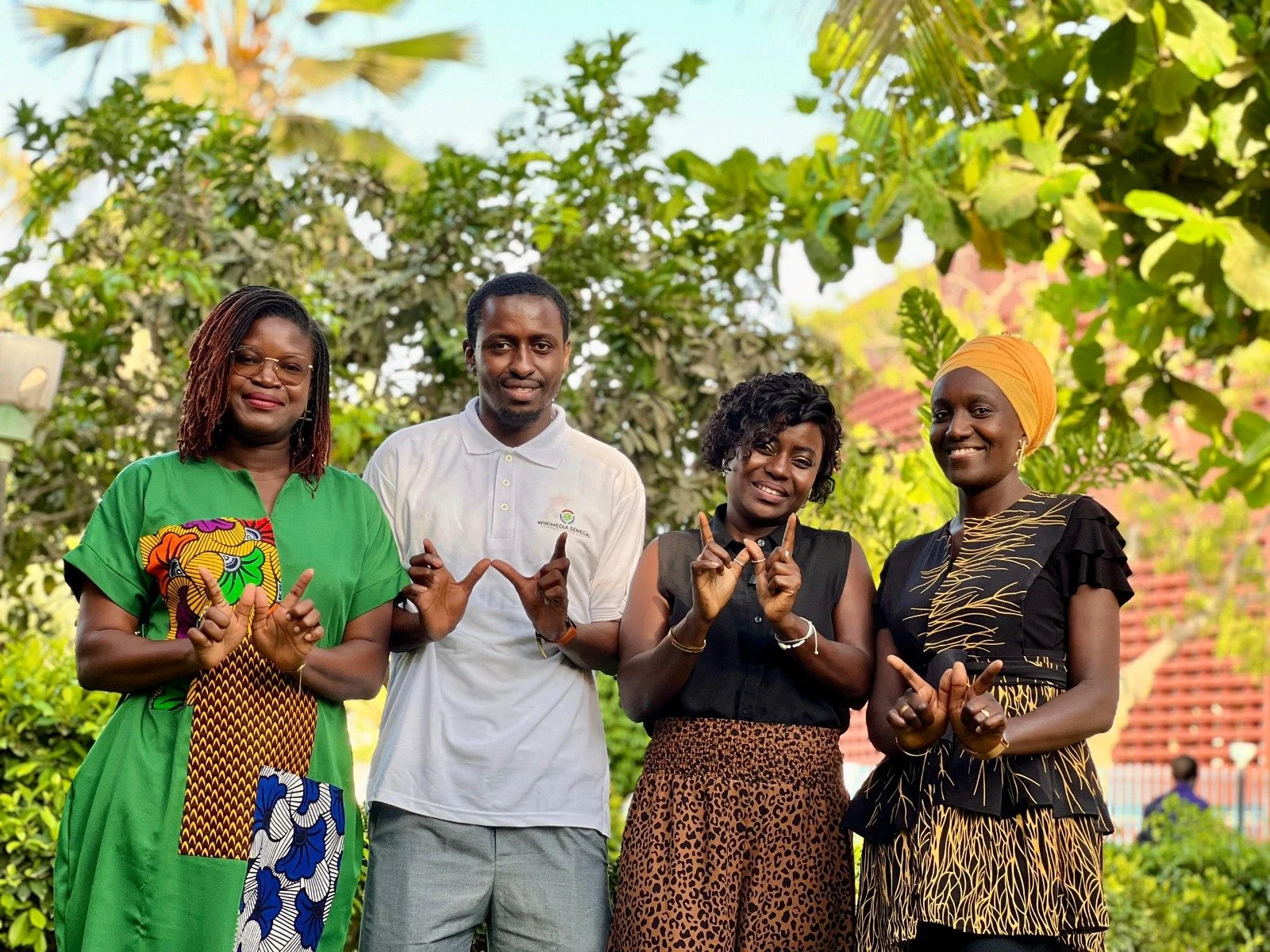
By Adjovi Essenam Fumey and Fatima Oury Sow Gueye, co-founders, Wikimedia Senegal
Across Wikipedia and other open knowledge platforms, the information that circulates about places, histories, and cultures often reflects global inequalities in access, documentation, and language. Senegal, like many countries across Africa, remains underrepresented across these digital knowledge infrastructures.
The Wikimedia Community User Group Senegal was created to change that. Led in part by women librarians and information professionals, the group works to strengthen local participation in Wikimedia projects, document Senegalese knowledge and heritage, and expand contributions in national languages.
What is Wikimedia Senegal?
Wikimedia Senegal is a user group dedicated to Wikimedia projects in Senegal. It is a volunteer-driven association that promotes free access to knowledge through collaborative platforms such as Wikipedia, Wikidata, Wikimedia Commons, and Wikiquote.
Our mission is to improve the representation of Senegal across open knowledge platforms by encouraging local participation and contributions.
How was the Wikimedia Community User Group Senegal created, and what need did it aim to address?
The group emerged from a simple observation: Senegal, like many African countries, is underrepresented on Wikipedia and other Wikimedia platforms.
At the time, there was no Wikimedia user group in Senegal, even though similar communities existed in neighboring countries such as Guinea, Mali, Benin, and Côte d’Ivoire.
We worked to obtain official recognition from the Wikimedia Foundation, the organization that hosts Wikipedia and other open knowledge projects. To reach that point, we organized trainings, mentored new contributors, and hosted numerous community events.
At the same time, we observed that many entries related to Senegal were missing, incomplete, or poorly written. Strengthening local contributions became essential.
From the beginning, we also focused on women’s participation, because content about women is still extremely limited across Wikimedia platforms—especially when it comes to African and Senegalese women. Our work includes encouraging more women to contribute and creating strategies that support greater inclusion.
Why is it important that knowledge about Senegal be produced and documented by people based locally?
Anyone can contribute to Wikimedia projects, but people based locally often have a deeper understanding of cultural, linguistic, and historical contexts.
They also have access to local sources and archives that may not be widely known internationally.
Producing knowledge locally helps reduce informational bias and strengthens information sovereignty. At the same time, contributors must follow Wikimedia’s editorial guidelines to ensure neutrality and avoid conflicts of interest.
What role do libraries, archives, and information professionals play in your work?
Two of the three founding leaders of Wikimedia Senegal are women librarians, which naturally shaped our approach.
We actively encourage librarians, archivists, and documentation specialists to engage with Wikimedia projects. Information professionals bring essential expertise in research methods, source evaluation, and proper citation practices.
Their professional culture also values rigor, scientific standards, and documentation norms, which are fundamental for building reliable content.
These professionals also help create bridges between Wikimedia and cultural institutions. Through these connections, we are able to organize events in libraries and documentation centers, collaborate with heritage institutions, and access reliable sources.
Women librarians played a central role in founding the group. Why was it important to center women’s leadership from the beginning?
Women have historically been underrepresented among contributors to Wikimedia projects.
In our case, two women librarians committed themselves to building the user group from the beginning. Placing women in leadership roles demonstrates that women are not only contributors, but also decision-makers, trainers, and visionaries within the Wikimedia ecosystem.
This leadership also allows us to actively work toward increasing both women’s participation and the visibility of Senegalese women in Wikimedia content.
How do national and local languages fit into your approach to sharing free knowledge?
Senegal is a multilingual country, and free knowledge cannot exist only in French.
Wikipedia already exists in Wolof and Pulaar, and a Serer-language Wikipedia is currently in incubation.
We encourage contributions in these languages whenever possible and work to raise awareness about the importance of documenting local realities in local languages.
However, contributing in these languages can be challenging. Although most Senegalese people speak Wolof, it is rarely taught formally in schools. Many contributors therefore lack the written foundations needed to produce encyclopedic content in their native languages.
As the education system evolves, we hope future generations will have stronger literacy in national languages, making it easier for them to contribute.
Languages are powerful carriers of memory, identity, and cultural heritage. Integrating them into Wikimedia projects helps preserve and promote this intangible heritage.
What are the main priorities for Wikimedia Community User Group Senegal in the coming years?
Our priorities include strengthening the technical and editorial skills of members so they can contribute more effectively to Wikimedia projects.
We also aim to develop partnerships with cultural and educational institutions in order to reach wider audiences and gain better access to reliable sources of information.
Another priority is increasing participation from women and young people, while continuing to document local knowledge and underrepresented cultural heritage.
Finally, we want to move from mainly participating in international Wikimedia campaigns toward developing initiatives that are designed and led locally within Senegal.