
Repro Uncensored · April 2026
Reporting focus: November–December 2025
How platform enforcement restricted essential health information, disrupted community networks, and narrowed civic space for reproductive rights, LGBTQ+ and sex worker-led organisations.
This report examines the late-2025 wave of restrictions across Meta’s platforms, drawing on documented incidents, testimonies and enforcement notices to assess the consequences for access to information, cultural expression and civic participation.
Download the full report (PDF)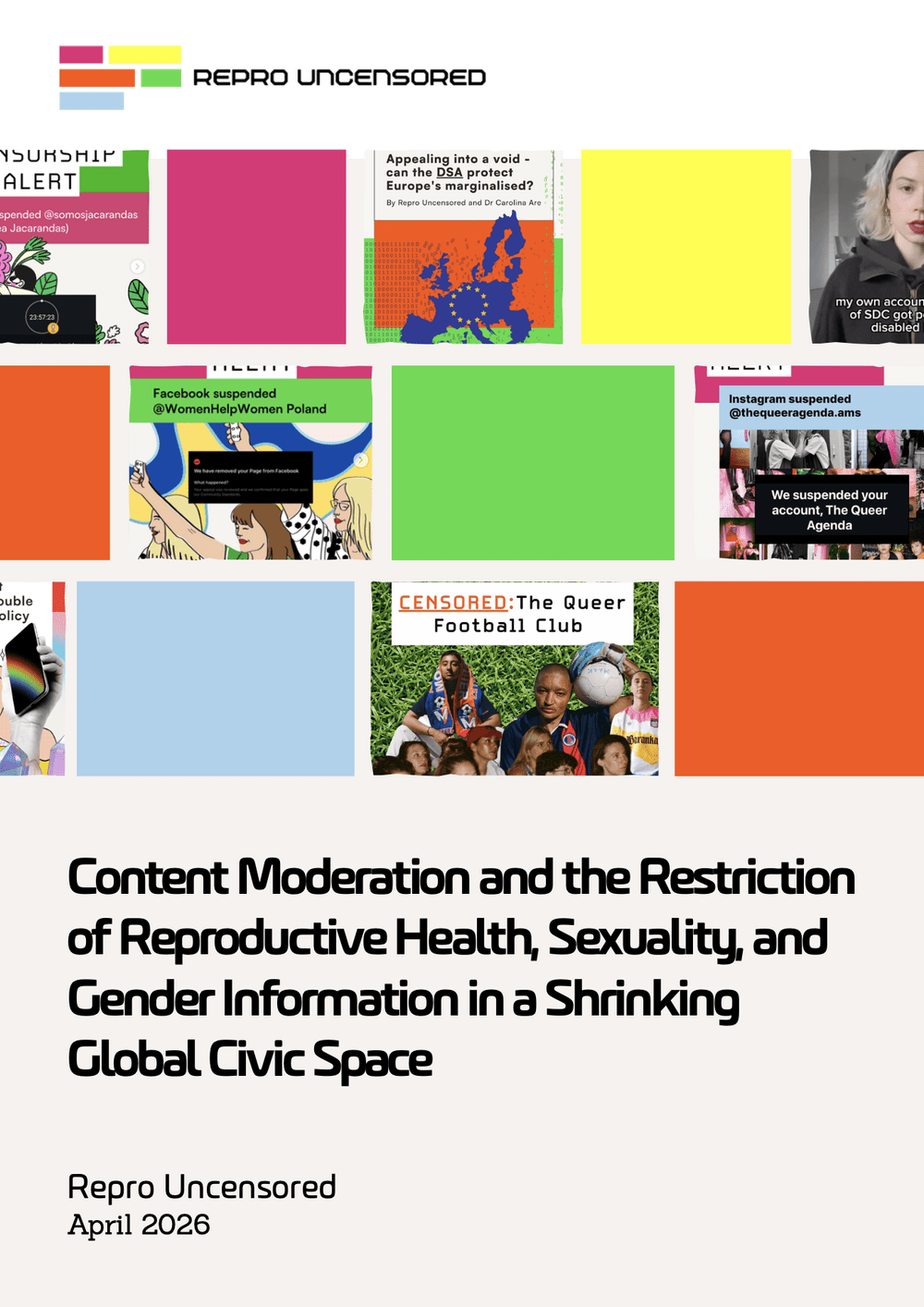
About the report
Between late November and the end of December 2025, nearly 100 organisations worldwide reported restrictions, removals or repeated disruptions affecting their accounts, content and services across Meta’s platforms. Those affected included abortion access providers, queer cultural platforms, feminist organisations, sex worker collectives, and pole and erotic dance communities.
The report examines how these restrictions extended beyond individual posts to entire accounts, community archives and messaging services used for essential health information. It places the enforcement wave within the wider context of shrinking civic space and examines the gap between formal platform safeguards and the experiences of affected communities.
The wave also drew international media attention, including coverage in The Guardian of restrictions affecting abortion advice and queer content. Further press coverage is linked below.
The wave in numbers
Repro Uncensored received 245 incident reports throughout 2025. Of the 125 submitted in November and December, 46 were reported in November and 79 in December. These figures describe reported incidents, rather than the total number of people or organisations affected.
Key findings
- Restrictions took multiple forms. Documentation included account suspensions, post removals, visibility suppression, loss of collaboration features and blocks on creating new or backup accounts. These measures could occur together, limiting both immediate communication and the ability to rebuild.
- Educational and cultural content was affected. Reported restrictions involved abortion information, sexuality education, harm reduction, menstrual health, queer culture, performance and sex worker safety. In many cases, the material was non-explicit, educational, artistic or informational.
- Enforcement often lacked clear explanations. In 82 of the 125 reports, no reason was recorded as having been provided for the removal. Where reasons were given, they included sexual activity, exploitation and human trafficking policies, general content violations and sensitive-content labels.
- Whole accounts and essential services were disrupted. Account removals cut off access to educational archives, community histories, audiences and support networks. Repeated restrictions on messaging services created instability for organisations providing time-sensitive abortion and health information.
- Identity verification created additional barriers. The report documents difficulties faced by trans, non-binary and performer accounts when identity documents did not align with the names used online, including professional or safety-driven names.
- Recovery could depend on outside pressure. Some accounts and services were restored only after media attention or public advocacy. Repeated cycles of removal and reinstatement left organisations without a dependable route to lasting resolution.
Experiences documented in the report
Jacarandas, Colombia
The feminist organisation reported repeated blocking of its abortion information hotline on WhatsApp. The report describes how these disruptions delayed access to time-sensitive information and support for people seeking abortions.
Women Help Women
Its Facebook account was suspended without warning in November 2025. The report records more than 33,000 followers and an estimated monthly reach of 80,000–120,000 people, illustrating the scale of the information network affected by a single account suspension.
Lara Billie Rense
The Dutch radio presenter and non-binary creator’s Facebook and Instagram accounts were removed during the enforcement wave. The report describes identity and naming requirements as a barrier in the case. Although the accounts were eventually reinstated following media scrutiny, the reason for the initial removal and prolonged disruption remained unclear.
What is lost when an account disappears?
For the communities documented in this report, platforms function as infrastructure for care, culture, organising and livelihoods. Restrictions can erase years of work, sever support networks and make essential information harder to reach. The consequences extend beyond online visibility to people’s ability to seek care, earn income and participate in public life.
Recommendations
The report calls for changes that make platform accountability accessible and effective for the communities most affected:
- Clear reasons and meaningful appeals. Provide specific explanations for enforcement decisions and timely, accessible routes to challenge restrictions and obtain redress.
- Protection for essential information. Introduce interim measures when restrictions disrupt access to health information or services.
- Dedicated support mechanisms. Establish reporting, escalation or helpline support for reproductive rights, LGBTQ+ and sex worker-led organisations facing censorship.
- Enforceable platform obligations. Use regulatory action, audits and penalties to address non-compliance, including under the EU Digital Services Act.
- Recognition of community evidence. Treat civil society documentation and community-generated evidence as relevant to regulatory scrutiny and enforcement.
- Longer-term structural change. Support strategic litigation, reform laws that encourage overbroad restrictions on lawful expression, and invest in alternative infrastructure for community organising.
In the press
These findings were covered by hundreds of media outlets worldwide. Selected coverage:
Methodology and scope
The report draws on submissions to Repro Uncensored’s Report an Incident tool, direct engagement with affected organisations, interviews, screenshots and enforcement notices. Each platform enforcement action is recorded as a separate case. The findings reflect reported and documented incidents and do not capture every instance of censorship. Cases without consent for public sharing are anonymised.
